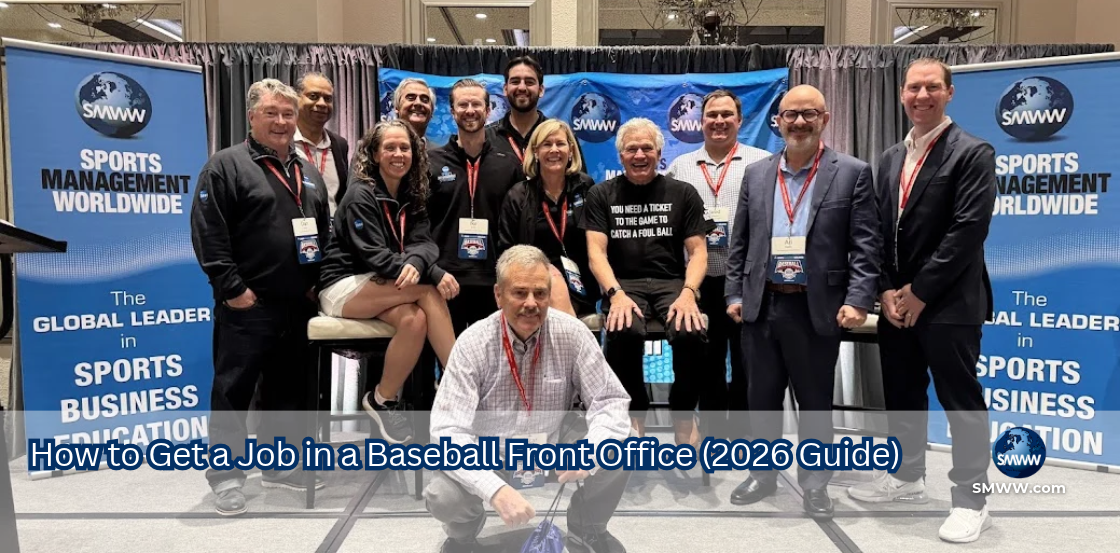
How to Get a Job in a Baseball Front Office (2026 Guide)
October 20, 2026
by


How to Get a Job in a Baseball Front Office
Getting a job in a baseball front office usually starts with an entry-level baseball operations, analytics, video, or scouting position, often following an internship, fellowship, or seasonal role. Teams look for candidates who understand the game, can demonstrate practical skills, and have built relationships within baseball. You do not need to have played professional baseball, but you do need to show how you can contribute to an organization.
What jobs are in a baseball front office?
Baseball front offices employ professionals in scouting, analytics, player development, video, and baseball operations, along with business departments that support the organization. Some of the most common entry-level positions include:
-
Baseball Operations Assistant or Associate: Supports the front office with research, reports, roster information, transactions, and administrative projects.
-
Research & Development Analyst: Uses baseball statistics, programming, and data analysis to help teams evaluate players and improve decision-making.
-
Video Coordinator or Video Scout: Records, organizes, and analyzes game footage to support scouting, coaching, and player evaluation.
-
Associate Scout or Area Scout: Evaluates amateur or professional players, attends games, and prepares scouting reports for an organization.
-
Player Development Assistant: Supports minor-league players, coaches, and development staff with performance information and organizational projects.
-
TrackMan or Pitch-Tracking Operator: Operates technology that captures pitch movement, velocity, and other performance data during games.
-
Ticket Sales, Marketing, and Communications: Works on the business side of baseball, providing another possible entry point into a professional organization.
Not every baseball front-office job requires the same background. An aspiring analyst may need programming experience, while a future scout may focus on player evaluation and writing reports.
The best starting point is identifying which department matches your skills and interests.
What skills do front offices hire for?
Baseball front offices hire candidates who can evaluate players, work with data and video, communicate clearly, and solve problems. The most valuable skills depend on the position.
Baseball Analytics and Technology
Modern baseball operations departments rely on data to support scouting, player development, and roster decisions.
For analytics-focused positions, employers may look for experience with SQL, Python, or R, along with an understanding of baseball statistics and data visualization.
Familiarity with technologies such as TrackMan and Statcast can also be useful.
Aspiring analysts can build relevant knowledge through programs such as SMWW's Baseball Analytics course.
Scouting and Player Evaluation
Scouting requires the ability to evaluate a player's current skills and project future performance.
Candidates should understand baseball fundamentals, player tools, the traditional 20–80 scouting scale, and how to write useful evaluation reports.
A strong scouting report explains not only what a player does well but also why that player may or may not succeed at a higher level.
Video Analysis
Video professionals need to organize footage, identify important sequences, and communicate useful observations to coaches and scouts.
Experience recording games, tagging plays, and preparing video reports can help demonstrate these skills.
Writing and Communication
Baseball operations employees regularly communicate information to scouts, coaches, analysts, and executives.
The ability to write a clear scouting report or explain a statistical finding can be just as important as collecting the information.
Spanish Language Skills
Spanish proficiency can be a significant advantage in player development and international baseball operations.
Organizations work with players from many Spanish-speaking countries, making effective communication an important part of supporting athletes and staff.
You do not need to master every skill. Focus on developing expertise that matches the baseball career you want.
Where are baseball front office jobs posted?
Baseball front-office jobs are posted on MLB and individual team career pages, sports employment websites, and specialized baseball job boards. Checking multiple sources regularly is more effective than relying on a single website.
Here are several places to begin your search:
-
TeamWork Online: Lists opportunities across professional sports, including MLB and Minor League Baseball organizations.
-
MLB Careers: Provides career opportunities with Major League Baseball and links to individual clubs.
-
MLB Club Career Directory: Helps applicants find employment pages for MLB organizations.
-
Baseball America Careers: Features a subscriber job board aggregating baseball opportunities, including scouting, analytics, and front-office positions.
-
WorkInSports: Provides listings across the sports industry, including baseball operations and business roles.
Search for job titles such as Baseball Operations Assistant, Baseball Operations Intern, Player Development Associate, Video Assistant, Scouting Assistant, and Baseball Research Analyst.
What about the MLB Winter Meetings and PBEO Job Fair?
The MLB Winter Meetings have traditionally been an important networking destination for baseball professionals and job seekers. The Professional Baseball Employment Opportunities (PBEO) Job Fair has also historically connected applicants with professional baseball organizations.
However, the 2026 offseason carries additional uncertainty.
As of October 20, 2026, MLB's current collective bargaining agreement is scheduled to expire on December 1, and a potential lockout could disrupt Winter Meetings activities and some major-league operations. The status of a 2026 PBEO Job Fair should be confirmed before making travel plans.
A lockout could delay certain MLB club decisions, but opportunities with minor-league organizations, colleges, agencies, baseball technology companies, and independent baseball businesses may still be available, depending on the employer.
Do not wait for one event to begin your job search. Monitor openings throughout the offseason and apply directly when opportunities appear.
How do you get noticed?
The best way to get noticed by a baseball front office is to demonstrate useful skills, gain experience, and build genuine professional relationships.
Start with practical experience.
Internships and Fellowships
Look for internships, fellowships, and seasonal roles with MLB organizations, minor-league teams, college programs, and baseball technology companies.
Even positions outside your preferred department can provide exposure to how a professional organization operates.
Informational Interviews
Reach out professionally to people working in baseball operations, scouting, analytics, and player development.
Ask about their career paths, the skills they use, and what they recommend for someone entering the industry.
The goal is to learn and build a relationship, not immediately ask for a job.
The SABR Community
The Society for American Baseball Research (SABR) provides opportunities to connect with baseball researchers, analysts, scouts, and industry professionals.
Regional chapters, research events, and analytics conferences can help aspiring baseball professionals develop knowledge and relationships.
Build a Public Portfolio
One of the strongest ways to demonstrate your ability is to produce work that an employer can review.
For example, you could:
-
Write scouting reports on college or minor-league players.
-
Create an analysis of a player's performance using publicly available statistics.
-
Develop a baseball analytics project using Python, R, or SQL.
-
Produce a video breakdown of a pitcher's mechanics or a hitter's approach.
A portfolio gives an employer evidence of what you can do, even before you have professional baseball experience.
Find Mentors
Mentors can provide feedback on your work, help you understand industry expectations, and introduce you to professional opportunities.
A mentor who knows your abilities may also be able to serve as a professional reference.
The combination of practical experience, demonstrable skills, and trusted relationships can help distinguish you from other applicants.
How SMWW graduates got into baseball
Sports Management Worldwide graduates have entered professional baseball through scouting education, fellowships, networking, and hands-on baseball operations experience.
Two publicly documented examples demonstrate how different career paths can lead into the industry.
Trey Rose — Pittsburgh Pirates Baseball Operations
Trey Rose completed SMWW's Baseball GM & Scouting course in 2016 while developing his baseball knowledge and industry relationships.
After working as an analyst and part-owner of MLB Reports, he secured a fellowship with the Pittsburgh Pirates in 2017.
That opportunity developed into a full-time baseball operations position. By 2022, SMWW publicly identified Rose as the Pirates' Assistant Director of Baseball Operations.
His path illustrates how specialized education, independent baseball work, and a fellowship can combine to create professional opportunities.
Elvis Martinez — St. Louis Cardinals, Minnesota Twins, and Tampa Bay Rays
SMWW graduate Elvis Martinez built his baseball career through networking and a willingness to pursue opportunities within professional organizations.
He entered baseball operations with the St. Louis Cardinals in 2017 before moving into communications and Spanish-language support roles with the Minnesota Twins.
His career subsequently progressed into communications and player relations with the Tampa Bay Rays.
Martinez's experience demonstrates that baseball careers do not always follow a straight line. Skills in communication, relationship-building, and player support can open doors across multiple departments.
These examples show that there is no single route into a baseball front office. Some professionals enter through analytics or scouting, while others build careers through fellowships, communications, and player development.
Explore more baseball career pathways through SMWW's Jobs in Baseball page.
How the Baseball GM & Scouting course helps
SMWW's Baseball GM & Scouting course helps aspiring baseball professionals develop scouting knowledge, practice player evaluation, and learn from experienced industry mentors. The eight-week online program includes live Zoom discussions with former Los Angeles Dodgers General Manager Dan Evans and 40-year Dodgers scout Hank Jones, along with training in scouting reports, player evaluation, baseball operations, and front-office decision-making. Students can develop practical work samples and professional relationships, while mentors may provide references based on their knowledge of a student's work.
Learn more about the Baseball GM & Scouting course and review the Baseball GM & Scouting FAQ.
Frequently Asked Questions
How do I get a job in baseball operations?
Start by applying for baseball operations internships, fellowships, seasonal positions, or entry-level assistant roles while building relevant skills and industry connections. Experience in scouting, analytics, video analysis, or player development can strengthen your application.
Create examples of your work, monitor baseball job boards, and connect with professionals who can provide advice about entering the industry.
Do you need to have played baseball to work in a front office?
No, you do not need to have played professional baseball to work in a baseball front office. Playing experience can be helpful for certain roles, but organizations also hire professionals with backgrounds in statistics, technology, business, communications, and research.
What matters is whether you have the knowledge and skills needed for the position.
What does a baseball operations assistant do?
A baseball operations assistant supports a team's front-office staff with research, data, reports, administrative tasks, and player-related information. Depending on the organization, responsibilities may include maintaining databases, preparing scouting materials, assisting with transactions, coordinating projects, and supporting analysts or player personnel executives.
It is one of several possible entry-level paths into baseball operations.
How much do entry-level baseball operations jobs pay?
Entry-level baseball operations assistant salaries vary by team, location, and employment type, but Salary.com estimated approximately $42,374 annually at the 10th percentile in October 2026.
The same source estimated an average baseball operations assistant salary of $44,256 per year in the United States.
These figures are market estimates, not guaranteed starting salaries. Internships, seasonal positions, and part-time roles may pay significantly less, so applicants should review each employer's posted compensation.
Source: Salary.com — Baseball Operations Assistant Salary, October 2026.
Do I need a degree in sports management to work in baseball?
No, a sports management degree is not universally required to work in baseball operations. Teams hire candidates with educational backgrounds in statistics, computer science, business, economics, communications, and other fields.
Relevant experience, baseball knowledge, technical skills, and professional relationships can all strengthen an application.
Specialized education, including SMWW's Baseball GM & Scouting and Baseball Analytics courses, can help candidates develop baseball-specific knowledge alongside their existing qualifications.