The Sports World Is Exploding — and It Needs a New Generation of Broadcasters
September 14, 2026
by


Sports has never been bigger, more global or more accessible.
New leagues are launching. Women's sports are setting attendance and revenue records. Traditional leagues are expanding internationally. Streaming platforms are competing for live games. Teams now produce their own podcasts, documentaries, social videos and behind-the-scenes programming.
Every game creates hours of potential content — and every piece of that content needs a knowledgeable, engaging personality to bring it to life.
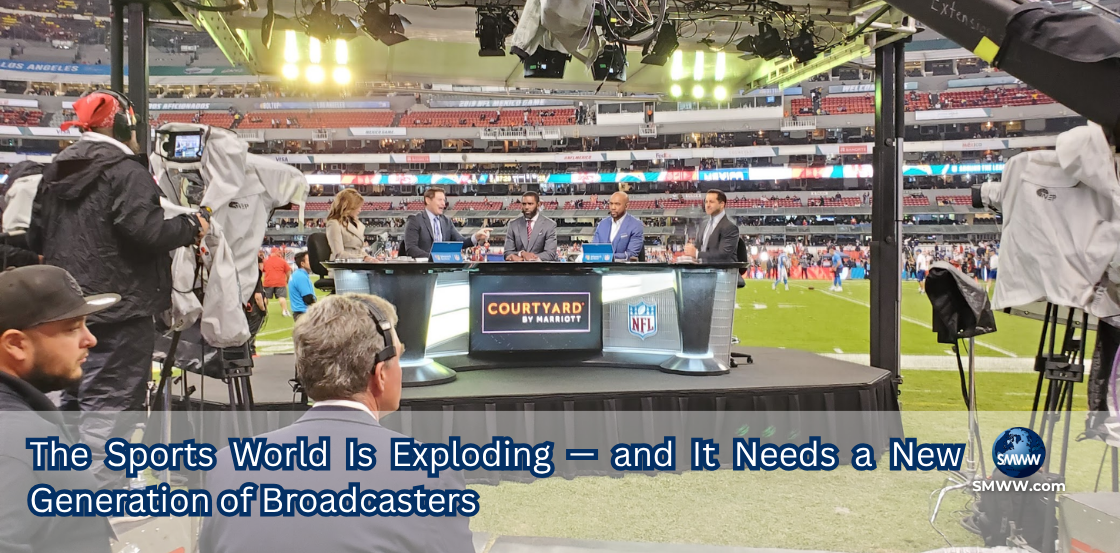
That is why the definition of a sports broadcaster has changed dramatically. The industry still needs play-by-play announcers and television analysts, but it also needs podcast hosts, digital reporters, sideline correspondents, content creators, studio personalities, esports commentators and experts who can translate sports data into stories fans understand.
More Sports Means More Stories
The sports calendar is becoming increasingly crowded. Established leagues are adding games and international events, while emerging leagues are creating entirely new audiences.
Women's sports is one of the clearest examples. Deloitte projects that global revenue from elite women's sports will reach at least $3 billion in 2026 — an increase of 340% in just four years. Broadcast revenue alone is expected to rise from $551 million in 2025 to $765 million in 2026.
The audience is growing with it. Nielsen reports that the National Women's Soccer League now has approximately 39.3 million fans, up from 30.8 million in 2023. Women's basketball, soccer, softball, hockey and volleyball are all generating new programming and storytelling opportunities.
International sports are expanding too. American football is staging more games overseas. Soccer leagues are cultivating fans on every continent. Cricket, rugby, Formula 1 and basketball are using streaming and social media to reach audiences far beyond their traditional markets.
These sports need people who understand their rules, athletes, strategies and culture — and who can make new fans care.
Streaming Has Removed the Limits of Traditional Television
For decades, aspiring broadcasters competed for a small number of jobs at television and radio stations. Those positions remain highly competitive, but television is no longer the only destination.
Games now appear on Netflix, Amazon Prime Video, YouTube, league-owned platforms and direct-to-consumer streaming services. Teams and athletes are becoming media companies themselves.
A single organization might need personalities for:
- Live game broadcasts
- Pregame and postgame shows
- Podcasts and livestreams
- Social-media videos
- Athlete interviews
- Team documentaries
- Fantasy-sports programming
- Betting analysis
- International broadcasts
- Sponsor-supported content
Nielsen found that viewing of streaming sports documentaries grew from approximately 4.7 billion minutes in 2021 to nearly 17 billion minutes in 2024. That content requires far more than someone holding a microphone. It requires researchers, interviewers, producers and storytellers who understand what makes sports emotionally compelling.
AI Is Producing More Data — but Fans Still Need Humans
Artificial intelligence is transforming sports coverage.
AI can process thousands of statistics, identify trends, generate graphics, create personalized highlights and compare player performance almost instantly. Teams and media companies can now analyze information that previously required entire research departments.
But data without interpretation is simply noise.
Fans do not just want to know that a quarterback's completion percentage dropped against a particular defensive formation. They want someone to explain why it happened, what the coach might change and how it could affect the next game.
AI can find the statistic. A talented sports personality makes it meaningful.
The strongest broadcasters of the future will know how to use AI as a research assistant without allowing it to replace their judgment, credibility or personality. They will verify the information, ask better questions and turn complex analytics into clear, memorable stories.
In an age when computers can generate unlimited content, authenticity becomes even more valuable.
The Modern Broadcaster Must Be More Than a Voice
A great voice is helpful, but it is no longer enough.
Today's sports personalities must understand the sport, prepare thoroughly, interview effectively and communicate naturally across multiple platforms. They need to be comfortable appearing on camera, recording a podcast, reacting live and developing their own professional brand.
They must also establish credibility. Fans can recognize immediately when someone understands the game — and when someone is simply reading information from a screen.
The most employable broadcasters will combine five qualities:
- Sports knowledge
- Preparation and research
- An authentic personality
- Digital and social-media skills
- The ability to explain analytics clearly
Aspiring broadcasters should not wait for a television network to give them permission to begin. They can call games for local schools, create a podcast, interview athletes, produce short videos and build a portfolio that demonstrates their abilities.
Your smartphone can become your first studio. Your social-media channel can become your first network. But professional training, constructive feedback and industry relationships can separate serious talent from the millions of people simply posting opinions online.
The Opportunity Is Bigger Than One Job Title
Government employment statistics still predict contraction in traditional radio and television announcing positions. At the same time, those figures do not fully capture the explosion of independent podcasts, streaming broadcasts, team-owned media, social content and contract work.
The old broadcasting ladder is narrowing. The sports-media universe surrounding it is expanding.
That creates opportunities for people who are versatile, knowledgeable and willing to build their own audience. It is especially promising for personalities who understand growing areas such as women's sports, international leagues, analytics and emerging sports.
The next great sports broadcaster may not be discovered sitting behind a traditional television desk. That person may begin by calling a college game, explaining statistics on TikTok, hosting an independent podcast or covering a league that mainstream media has overlooked.
Sports continues to expand because fans want more access, more information and more connection to the games they love.
AI can organize the numbers. Cameras can capture the action. Streaming services can distribute it around the world.
But sports will always need compelling human personalities to tell the story.
If you can inform, entertain and make an audience feel closer to the game, there has never been a more exciting time to develop a career in sports broadcasting.
Build Your Voice With SMWW
Sports Management Worldwide offers two courses built specifically for the modern sports media professional:
The Sports Broadcasting course develops your on-air skills, on-camera presence, and broadcasting fundamentals — taught by active industry professionals who understand what the market demands right now, not what it looked like a decade ago.
The Sports Media & Content Strategy course is built for the digital era — covering podcast production, social media strategy, content creation, digital storytelling, and how to build a personal brand that stands out in a crowded media landscape.
Together, they cover the full spectrum of where sports broadcasting is going — from the traditional broadcast booth to the podcast studio to the content platform. Learn how to build your voice, sharpen your on-camera skills and gain practical industry knowledge through Sports Management Worldwide's sports broadcasting education and mentorship opportunities at SMWW.com.
Sources: Deloitte Women's Sports Revenue Report and Nielsen Tops of Sports Report.